
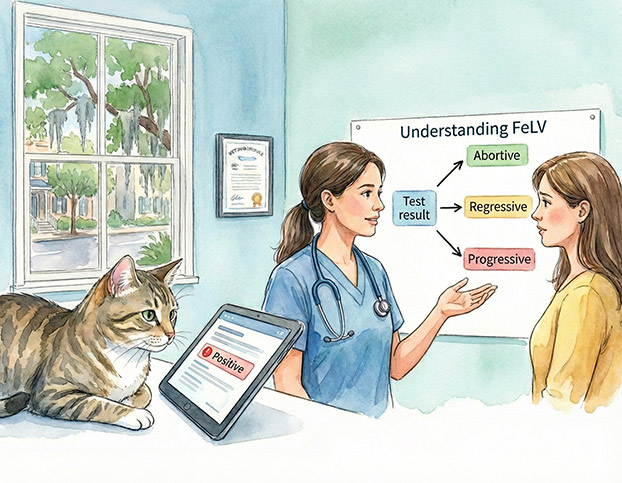
Receiving a positive Feline Leukemia Virus (FeLV) test for your beloved cat is scary. As a pet owner, you might immediately fear the worst after Googling the diagnosis: a shortened life span and severe illness.
But don’t panic just yet: That initial test is just a snapshot in time—it doesn’t tell us the whole story.
Savannah Veterinary Internal Medicine: Making Sense of Your Cat’s Test Results
For pet owners in Savannah, Pooler, and the surrounding Lowcountry, it is important to understand that an FeLV diagnosis is not a “one size fits all” condition.
The test your regular vet ran is only the first step. The final outcome depends entirely on the strength of your cat’s specific immune response.
FeLV has three possible paths once it enters the body—complete elimination of the virus (Abortive Infection), a hidden carrier state (Regressive Infection), or active illness (Progressive Infection). The only way to know which path your cat is on—and if they are truly sick—is to look deeper.
This guide breaks down why that first positive test isn’t necessarily a death sentence, and how our specialists use advanced testing to tell the difference between a manageable condition and aggressive disease.
What is FeLV (Feline Leukemia Virus)?
FeLV stands for Feline Leukemia Virus. It is a serious and complex virus that only affects cats (it cannot be spread to humans or dogs). It’s classified as a retrovirus, meaning once a cat is persistently infected, the virus can become a permanent part of their genetic makeup (it gets permanently woven in the bone marrow and blood cells). The “persistently infected” is the key.
The main danger of FeLV is that it attacks and weakens a cat’s immune system, leaving them vulnerable to other infections and certain types of cancer.
The main danger of FeLV is that it attacks and weakens a cat’s immune system.
How Do Cats Become Infected With FeLV?
Cats catch FeLV through intimate, close—typically prolonged—contact with cats actively shedding the virus (more on this later). For example, an infected cat simply walking by another cat is not how the virus transmitted. The virus is primarily shed in the infected cat’s saliva, but it can also be found in nasal secretions, urine, and feces.
Common methods of spread:
- Mutual Grooming (sharing saliva)
- Fighting (transmitting the virus through bite wounds)
- Sharing Food/Water Bowls or Litter Boxes (less common, but possible)
- Mother to Kitten: An infected mother can pass the virus to her kittens
Key takeaway:
The virus is fragile and dies quickly outside of the cat’s body, so cats can’t pick it up from surfaces like you would a human virus. Direct, close contact with an infected cat is the necessary link.
A Tale of Two Tests: SNAP vs. PCR
To truly understand your cat’s health, we need to look at the virus in two different ways. FeLV is diagnosed using a combination of two specific blood tests. Understanding the difference between them is critical for knowing if your cat is safe, or if health problems are on the horizon.
- The “Screening” Test (SNAP ELISA) This is the test your regular veterinarian likely performed.
What it looks for: This test detects viral proteins (antigen) that the virus sheds, floating in the blood.
The Limitation: It cannot see the virus if it is hiding inside the bone marrow and blood cells (regressive infection).
- The “Confirmatory” Test (Quantitative PCR) This is the advanced test necessary to determine if your cat is permanently infected.
What it looks for: This test detects the quantitative amount of the virus’s genetic material (DNA) inside the cells.
The Advantage: It is highly accurate. A high number confirms a progressive infection, while a low number often reveals a regressive “Carrier” that other tests miss.
The 3 Ways FeLV Infection Plays Out
FeLV infection is complex because its outcome is determined by the speed and strength of your cat’s immune system. Understanding these three primary clinical outcomes is key to forming an accurate prognosis.
- Abortive Infection
This is the best-case scenario, and we all hope for this outcome.
In an abortive infection, the cat’s immune system recognizes the virus immediately and mounts a strong, rapid defense. The body completely eliminates the virus before it can take hold, essentially curing itself.
The Status: The cat is not infected, not contagious, and does not carry the virus in its DNA.
The Test Results: Because the virus is gone, all tests (both standard SNAP and PCR) will be Negative.
- Regressive Infection
This is what is commonly known as being a “Silent Carrier.”
In a regressive infection, the immune system successfully suppresses the active virus but cannot fully eliminate it. The virus retreats from the blood stream and inserts itself into the cat’s bone marrow DNA.
The Status: The cat is usually healthy and does not shed the virus, meaning they are generally not contagious. However, the infection acts like a “sleeper cell.” Severe stress or immune suppression can cause the virus to reactivate later in life. Think of this like Shingles in humans. The chickenpox virus is dormant (sleeping), but severe stress, illness, or immune-suppressing medications can cause it to “wake up” causing Shingles.
The Test Results: This is where diagnosis gets tricky. The initial rapid test (SNAP) is often Negative because there is no active virus in the blood, but the PCR test will be Positive because it detects the hidden DNA.
- Progressive Infection
This is considered a “Full-Blown” active infection.
In a progressive infection, the immune system is overwhelmed and fails to contain the virus. The viral DNA remains active and is constantly replicating new infectious virus particles throughout the body.
The Status: The cat is contagious to other cats. Because the virus is unchecked, these cats are at high risk for FeLV-associated diseases, such as lymphoma, leukemia, secondary infections, stomatitis, or severe anemia, and require close management by a specialist.
The Test Results: Because the virus is present everywhere, both the SNAP and PCR tests will be Positive.

Why One Test Isn’t Enough: Our “Double-Check” Approach
This is the most important takeaway for Savannah and Pooler cat owners: Because the difference between being a Carrier (Regressive) and being actively sick (Progressive) is life-changing, a single rapid test is not enough. You must confirm your cat’s true status with follow-up testing.
Important Tips:
Avoid Saliva Tests: While at-home saliva or tear test kits are available online, they are not recommended. Recent data shows they have low sensitivity and miss nearly half of infected cats. Stick to blood tests run by your vet.
The 30-Day Rule: If your cat was bitten or exposed to a stray yesterday, do not test today. It takes at least 30 days after exposure for the virus to show up on a test. Testing too early leads to a false sense of security.
The Sick Cat Warning: If your cat is currently very sick (specifically with severe anemia or immune-mediated disease), false positives can occur. Once the illness is controlled, the test may turn negative. Always retest once your cat is stable.
Living with FeLV: Care for the “Progressively” Infected Cat
If your cat is confirmed to have a Progressive infection (“Full-Blown” case), our focus shifts entirely to maximizing their quality of life.
While the prognosis is guarded—with many cats facing significant health challenges within the first few years—proper management can make a world of difference. Our goal at Savannah Veterinary Internal Medicine is to help your cat live comfortably for as long as possible by managing the specific risks their immune system can no longer handle.
Proper management can make a world of difference.
Here are the essential “Rules of the Road” for managing an FeLV+ cat:
1. The “No Raw Food” Rule
This is critical for immune-compromised cats.
While raw diets are popular, they are dangerous for FeLV patients. Because your cat’s immune system is weakened, they cannot fight off the common bacteria (like Salmonella or E. coli) often found in raw meat or unpasteurized dairy.
The Fix: Stick to a high-quality, balanced commercial feline diet. It is the safest way to provide nutrition without the bacterial risk.
2. The “Catio” Solution (For Savannah, GA Cats)
We know Coastal Georgia cats love the outdoors. However, strict indoor confinement is essential to prevent them from spreading the virus to others—and to stop them from catching new illnesses.
The Fix: If strict confinement causes your cat distress, consider building a “Catio” (a secure outdoor enclosure). This keeps them safe from fights and roaming while allowing them to enjoy the fresh Lowcountry air, reducing the stress that can trigger viral flare-ups.
3. The “Flea Factor” (A Savannah & Lowcountry Specific Warning)
In our region, fleas are more than just a nuisance; they are a medical threat. Fleas transmit a blood parasite called Mycoplasma that attacks red blood cells.
The Risk: In a healthy cat, this is annoying. In an FeLV cat, a flea-borne Mycoplasma infection can trigger severe, life-threatening anemia.
The Fix: Strict, year-round flea control is not optional—it is a lifesaver. Do not skip a month, even in “winter.”
4. Watch the Mouth (Gingivostomatitis)
FeLV cats are prone to severe, painful gum inflammation known as stomatitis. The virus prevents the mouth from healing, leading to chronic pain.
The Signs: If your cat has bad breath, is drooling, drops food, or seems hesitant to eat, schedule a vet visit immediately. Pain management and dental care are top priorities for their comfort.
Final Word: Prevention and Screening in Coastal GA
The best way to fight FeLV is to prevent the infection from starting and spreading. Because Savannah and the Lowcountry have a large population of free-roaming community cats, the risk of exposure here is real.
Here are the essential steps for every pet owner to keep their household safe:
- Vaccination Protocols
- Kittens: Vaccination is considered a “core” requirement for all kittens, as they are the most susceptible to infection.
- Adults: Your vet can tailor the schedule based on your lifestyle. If your cat lives strictly indoors alone, vaccination might not need to be boosted. However, if they have access to a “catio” or live in a multi-cat household, annual boosters are highly recommended to keep their immunity strong.
- Test Before Introduction (The Golden Rule) This is the most common way we see the virus spread in well-meaning homes. If you are introducing a new cat or kitten into your family—even a cute stray you found in the neighborhood—they must be tested for FeLV before they meet your other pets.
- The Rule: Keep the new cat completely separated (different room, different bowls) until you have a negative test result in hand.
- Pro Tip— For Total Peace of Mind: While a standard SNAP test is excellent for detecting active illness, it can sometimes miss a hidden “Regressive” infection. You might have picked up on this possibility in the chart above. Therefore, if you want absolute certainty before bringing a new cat into a negative household—or if you plan to breed your cat—we recommend asking for a PCR test in addition to the standard screen. This ensures you aren’t bringing a “Silent Carrier” into your home.
Conclusion: Accurate Diagnosis is the Key to Care
Understanding your cat’s true FeLV status—distinguishing between an Abortive, Regressive, or Progressive infection—is the most critical step in providing the highest quality of life.
An FeLV diagnosis is serious, but it is not a vague “wait and see” situation.
Savannah Veterinary Internal Medicine is here to guide you through the diagnostics and management needed to give your cat the best possible prognosis.
Partner with Savannah and the Lowcountry’s Veterinary Internal Medicine Experts
You do not have to navigate a confusing FeLV diagnosis alone. Whether you need a confirmatory PCR test to rule out a false positive, or a long-term management plan for a Progressive infection, expert help is right here.
At Savannah Veterinary Internal Medicine, we specialize in “medical detective work.” We serve pet owners across Savannah, Pooler, Richmond Hill, and the entire Lowcountry who need more than just a screening test—they need answers.
While we welcome referrals from your primary veterinarian, they are not required. Simply call or contact us to schedule your consultation today.
Author:
James Woods DVM, MS, DACVIM (SAIM)
Ph: (912) 721-6410
Contact Us